
TRILOR Disks
DISCS IN HI-TECH MATERIAL FOR DENTAL PROSTHESIS WITHOUT METAL
Trilor is the most innovative material of the market for dental prosthesis.
Trilor, developed by Bioloren, is a new generation polymer composed of a (thermoset) resin and multi-directional fiber glass reinforcement.
FRC (Fiber Reinforced Composite) are materials used in airplanes and other sectors where the high resistance and low weight are essential requirements.
The multi-directional braided fiber structure offers good performance in terms of load and tension distribution in response to forces applied from different angles making it an ideal material for permanent and temporary dental restorations.
Resistant
With significantly higher flexural strength compared to other metal free materials.
Trilor is a very resilient material.
As a result of the 5-year chewing tests (1,200,000 cycles) intact and suitable for use as permanent material
Flexural strength
- Trilor 540 MPa
- Carbon fibre 250 MPa
- Peek 150 MPa
Elastic
Trilor is a material with an elasticity close to that of dentin
Trilor ensures perfect mechanical compatibility with both biological and synthetic materials with which it interacts.
The excellent adhesion between the fibers and the matrix, combined with a great surface contact, allows the dispersion of occlusal forces through the structure of the matrix itself.
LIGHT
Trilor is extremely light, 3 to 5 times lighter than cobalt-chrome or zirconia frameworks.
For this reason it is extremely more comfortable for the patient, especially on extended prostheses, and does not stress the mucous membranes
BIOCOMPATIBILE
Trilor is extremely biocompatible, respecting the highest international safety standards.
The metal free Trilor structure is free from bi-metallism and equipped with a technology capable of minimizing the absorption of liquids resulting insoluble in the oral environment.
Trilor structures are chemically stable and free from corrosion and oxidation.
EASY PROCESSING AND REPAIR
Trilor, being neither melted nor sintered, always maintains its size and is processed
Being a glass-polymer it binds directly with aesthetic materials and can be repaired directly in the studio with composite materials.
Ivory-white in color, it is a highly aesthetic camouflage material and does not require opacification.
Trilor saves a lot of time
Indications for use
Fixed prosthesis:
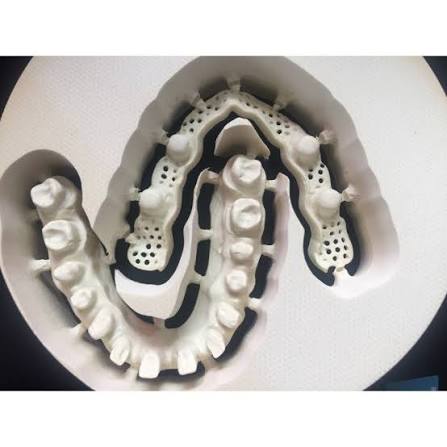
- Hoods and bridges both front and rear
- Telescopic crowns (primary and secondary)
- Bridges for permanent and provisional restorations, cemented and non-cemented (screwed)
- Adhesive fastening systems both lingual and palatal (ex: Maryland)
Removable prosthesis on implants:
- Reinforcing bars for screwed removable dentures
- Toronto bars
- Screwed sub-structures and coupling superstructures
Partial removable dentures:
- Reinforcement structures (nets and plates)
Orthodontics:
- Adhesive fixing elements
- Anchoring structure for adhesive fixed orthodontics
- Connection frames (orthodontic with bone screws)
- Orthodontic retainer
Trilor framework can be designed using the most famous CAD software
Trilor can be milled with most wet and air-cooling CAM machines on the market
Trilor can be coated using different materials:
- Composite
- Zirconia
- nanoceramics (Crystal Ultra)
- Lithium disilicate
- PMMA acrilylic
- Feldspatic ceramic
- artificial teeth
- veneers
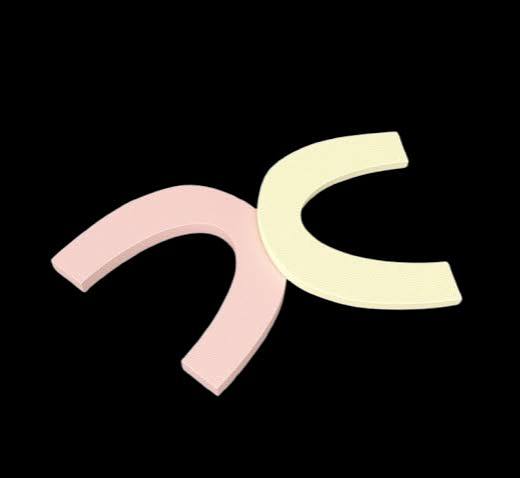
Trilor disk is available in 2 shapes and 2 colours (white or pink)
FAQ
BONDING QUESTIONS:
Is the bonding step necessary when bonding TriLor to Composite?
- Yes, every bit helps.
What is the bonding process for TriLor?
- Here is a run-down of the process after milling TriLor
Sandblast Steam Air dry Make your restorations using your conventional methods (zir, lithi) Now you’re ready to put them together! Add dip wax to your glazed restoration in the areas that you’re not going to have cement Apply ceramic primer to the restoration Apply composite primer to the TriLor Air dry Cement crown—use the right cement color!
Clean up excess cement Sandblast Add composite primer to TriLor areas Add ceramic primer around areas that ceramic will touch the TriLor Apply composite
Cure Air Barrier around composite work Final cure Contour, etc Stain glaze Light Cure
What bonding material can I use on TriLor?
- Whatever bonding cement you currently use will work, just be sure it doesn’t have any geometric changes like shrinkage or expansion that you hadn’t accounted for. Apply the acrylic resin or composite directly to the TriLor®, performing the operative protocol as dictated by the manufacturer of the aesthetic material.
- Adhesion protocols for the TriLor are as follows:
- Acrylic
- Sandblast the TriLor with AlO2 at 2 Bar (50 microns-110 micron);
- Air dry well (Oil and water free line);
- then wet the TriLor with acrylic resin and bond.
- Composite
- Sandblast the TriLor with AlO2 at 2 Bar (50 microns-110 micron);
- Air dry well (Oil and water free line);
- Prime with composite primer and proceed to apply as you would.
- Please follow instruction for the composite you use.
- Lithium Disilicate
- Sandblast the TriLor with AlO2 at 2 Bar (50 microns-110 micron);
- Air dry well (Oil and water free line);
- Sandblast the internal part of the crowns, use etching gel (as recommended) and bond with Universal Resin Cement
- Acrylic
- Ti-Bases~
- Sandblast the TriLor with AlO2 at 2 Bar (50 microns-110 micron);
- Air dry well (Oil and water free line);
- Sandblast the intimate part of the Ti-Base, and bond with Universal Resin Cement.
GENERAL QUESTIONS:
TriLor Metal Free Dental System
Is TriLor only Digital?
- TriLor comes in puck form that accommodates most milling machines and indication. Those who are analog can still benefit from TriLor’s qualities with the TriLor Arch, a cleaver and easy way to fabricated implant supported bars, manually.
What is the minimum vertical thickness on a thimble frame?
- The minimum thickness for the TriLor material is 3.5mm however a thimble can typically range 6-8 mm, so the vertical restorative space the patient exhibits will provide for the thimble thickness, which is a reduction of 1.0mm to accommodate a crown.
Meaning 3.5mm is the minimum thickness, but it won’t be very retentive for a crown to be cemented on it, so it’s best to have the thimble 1.0mm less than the final size of the crown.
As far as minimum thicknesses, the indication for that with TriLor is 3.5mm, meaning it should not be reduced to less than 3.5mm in order to maintain its geometric stability; nonetheless, when doing a thimble type of substructure be careful at the preparations and particularly at the ginigival third to not go below 3.5mm.
Rather in CAD design, you want to have it 1mm less than the final design.
That allows a uniform thickness on your crown and/or over-denture; the more uniform overall, the better support it enjoys.
Also, the Anterior-Posterior spread really has to be adhered to, and I would be on the more cautious side to prevent any failures.
It is a fantastic product that is very strong, but maintaining thicknesses will provide you with greater yield strength and stability.
Is TriLor approved for permanent restorations?
- Yes
What is the flexural strength?
- 540 Mpa
- What is the Tensil strength? 380 Mpa
What pink composite do you prefer?
- Any, as long as they are light cured, they will work with TriLor®
What workflow/modules do I use for Trilor in a 3 Shape Scanner?
- If you are doing a partial framework you would use the RPD module in your 3 Shape or if a crown or bridge use the Crown and Bridge design module; if it’s an all-on-X, then you will need the implant and bar module. If you have the Complete Restorative software, you should have both modules. 3Shape TriLor Library and material files available for import. After designing the bar, simply copy and append, clear out the order form and design the individual restorations.
Trilor Arch is the cheapest (no milling machine), fastest and easiest solution (less than 30 minutes to prepare the framework to cover) for a permanent full arch prosthesis.
Trilor Arch is ideal for immediate loading on implants.
The objective of the prosthetic restoration is to restore the anatomy, functionality and aesthetics of partial or total edentuality.
The success of a prosthetic therapy depends on a correct treatment plan that represents the sum of medical and operative knowledge, also involving other operators under the guidance of the clinician.
The factors that the clinician must evaluate are:
- the predictability of the reconstruction
- the biocompatibility
- the functionality
- the phonetics,
- the aesthetics,
- the duration in time,
- the economy
Physical properties:
- Tensile Strength 380 Mpa
- Flexural Strength 540 Mpa
- Flexural Modulus 26 Gpa
- Compressive Strength (perpendicular) 530 MPa
- Density 1,8 g/cm3
Related products
-
 CAD/CAM
OCCLUSIONVD
-
CAD/CAM
POST & CORE
-
CAD/CAM
EFFECT SHADE
-
 LABORATORY
TRILOR ARCHE